


The Story of Winnie the Pooh


For the past 100 years, Winnie the Pooh has been loved by children. But fame wasn't so enchanting for the real Christopher Robin. Back in his day, he was more famous than Harry Potter.
Before they became a favourite in children's literature, Christopher Robin Milne and Winnie the Pooh were just a boy and a bear, romping around the London Zoo, not the Hundred Acre Wood.
In the 1920s, Winnie, the real bear, was a main attraction at the zoo. He was so friendly that her keepers allowed select children to feed and play with her. Her gentleness was likely the result of being hand-raised by an officer in the Royal Canadian Army Veterinary Corps during the First World War.
Where did Winnie the Pooh come from?
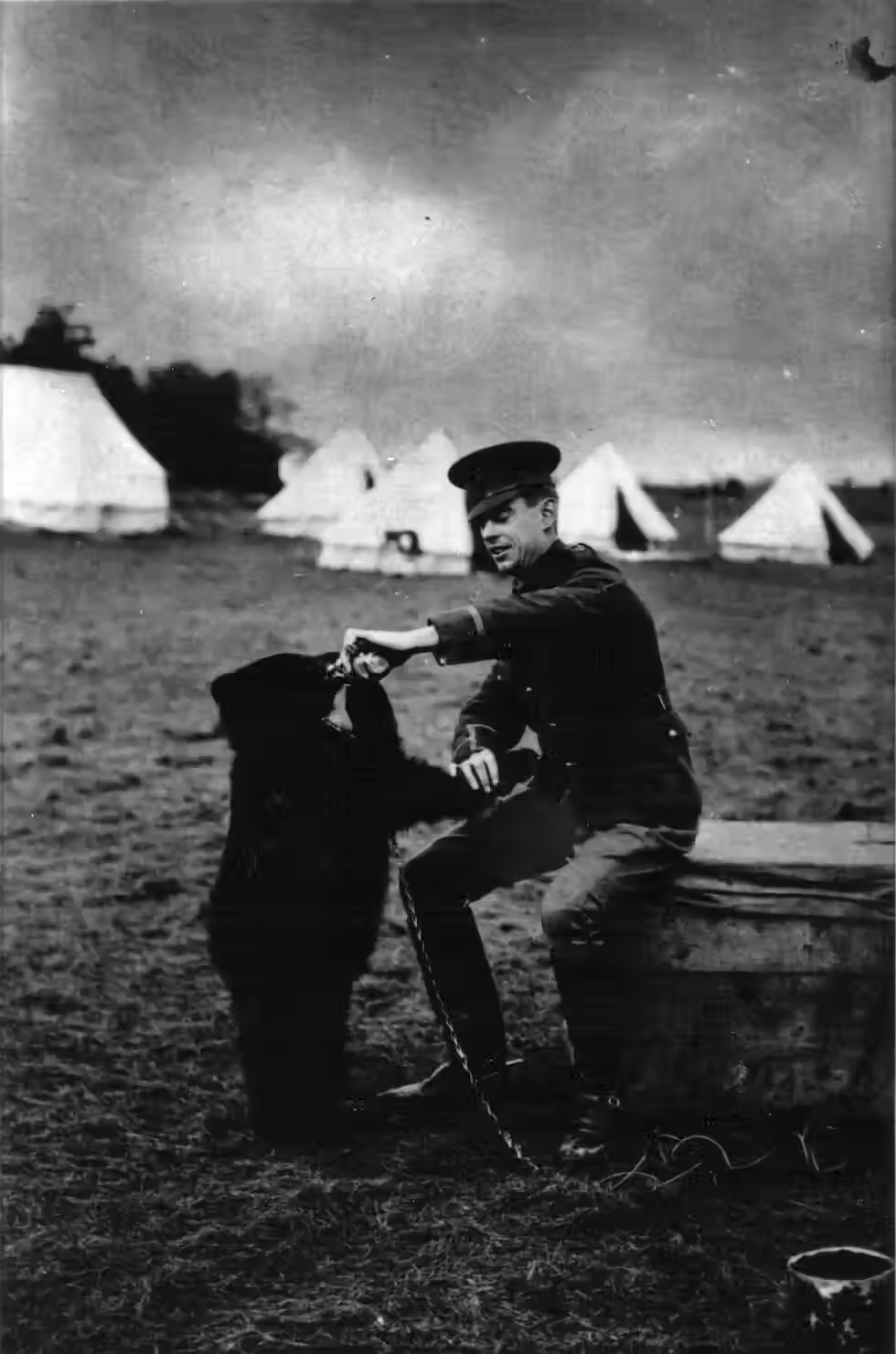
It started with a friendship between Lt. Harry Colebourn and the cub he named for his adopted hometown of Winnipeg.
On Aug. 24, 1914, Colebourn bought Winnie for $20 from the hunter who had killed her mother in White River, Ontario. He was on his way to training in Valcartier, Quebec. There, Winnie became the beloved mascot of the Canadian Veterinary Corps. She was allowed to wander the camp, hoping someone would feed her apples and condensed milk and often posed for photos in a soldier's lap.
On Oct. 3, 1914, she sailed with the Canadian troops to England, where the troops continued training at Salisbury Plain.
Even there, she was allowed to roam free. There are even reports that she slept under Colebourn's cot in the tent.

But she could not follow the men to the front lines in France. So, Winnie was sent to the London Zoo.
This is where history was made.
Young Christopher Robin would apparently whisper to a particular zookeeper, who would then unlock a series of doors to allow the boy into Winnie's cage. That is according to his father, A.A. Milne’s,(FILM) introduction to Winnie-the-Pooh, pu
blished on Oct. 14, 1926.
A.A. Milne captured the innocence and bliss that belong only to childhood, and that captivated readers' hearts. The Winnie the Pooh books became an almost-overnight success, selling more than 150,000 copies in the U.S. alone by the end of 1926, less than three months after its publication.
But Winnie’s fame turned out to be more of a curse than a blessing for the author and his son.
Eventually, Mr. Milne grew to resent the way Winnie-the-Pooh overshadowed the rest of his life. He wanted to be known for his wider body of work, which included mysteries, poetry and West End plays, not just for his children's stories.
The true cost of the stories was paid by Christopher Robin himself. He became one of the most notable children in the world in the 1920s, alongside Shirley Temple and Princess Elizabeth.
In the beginning, he liked the attention. But as he grew up, he became the target of bullies at school. He chose to serve in the Second World War just to prove to himself he was more than a storybook character.
The father and son remained especially close from about Christopher Robin's 10th birthday into his early 20s. But the two drifted apart when Christopher Robin came home from war.
At that point, he began to resent the role his father had cast him in.
In the final years of A.A. Milne's life, the two men rarely saw one another.
Winnie's story ended in 1934, when she died at the age of 20.
When Lt. Colebourn returned from the war, he visited Winnie often, and her popularity was one reason he changed his mind about bringing Winnie back to Canada. He never saw the bear again after 1920, when he moved home.

Winnie the Pooh paid tribute to the Canadian who brought him to England, when he told Piglet: "If ever there is a tomorrow when we're not together, there is something you must always remember. You are braver than you believe, stronger than you seem, and smarter than you think. But the most important thing is, even if we're apart, I'll always be with you."


Comments