


The Great St. John’s Fire

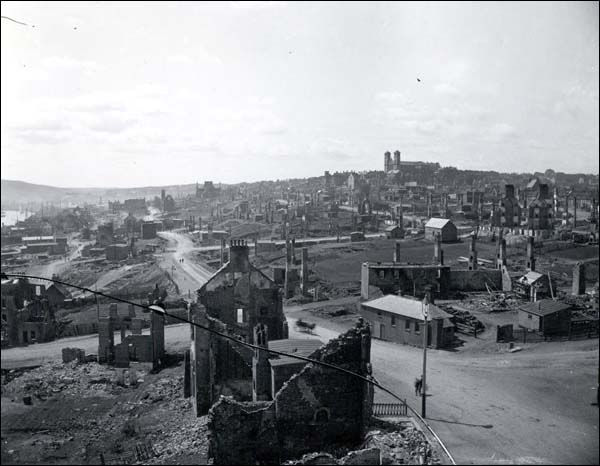
Did you know St. John’s was destroyed by a fire in 1892?
Late in the afternoon of July 8, 1892, a small fire broke out in a St. John's stable after a lit pipe or match fell into a bundle of hay.
The flames quickly spread due to dry weather conditions, a disorganized fire department, and poor planning by city officials.
Within hours, the fire had destroyed almost all of St. John's, leaving 11,000 people homeless and causing $13 million in property damage.
The stable was at the top of Carter's Hill. It was close to the corner of Freshwater and Pennywell Roads – an elevated location near the city's centre.
Firefighters arrived at the scene 30 minutes later but were unable to contain the blaze due to a water shortage.
Although a huge water tank was located just metres from the stable, it was almost empty because firefighters had forgotten to refill it after a recent practice drill.
Hydrants were also useless because of low water pressure.
Earlier that morning, Municipal Council Chairman Thomas Mitchell ordered the city's water supply shut off to lay down new pipes; he did not inform other councillors of his decision, nor did he consult a city engineer.
Although workers had turned the supply back on at three o'clock, the water pressure was not strong enough to force water to the city's higher regions, including the one where the fire began.

A strong wind was blowing that day, fanning the fire and carrying sparks and burning debris from one rooftop to another. Unfortunately, firefighters had neglected to bring their hatchets and could not tear down any buildings in the area to make a firebreak.
The fire swept down Carter's Hill and along Freshwater Road until it divided into two at the intersection of Harvey Road and Long's Hill. By six o'clock that evening, many began storing their valuables in the Anglican Cathedral, Gower Street Methodist Church, and other stone or brick buildings they believed could withstand the flames.
As the fire made its way downtown, however, it also gutted many of these structures; the Anglican Cathedral suffered so much damage that it took workers more than 10 years to completely restore it.
The fire burned into the night and did not end until about 5:30 the following morning.
Many people camped out in Bannerman Park or on the property surrounding the Roman Catholic cathedral, which was one of the few buildings the fire did not destroy.
As the sun rose on July 9th, more than two-thirds of St. John's lay in ruins, and 11,000 people were homeless; many had lost everything they owned, and three people were dead.
The fire prompted government officials to reorganize the city's fire departments.
Before the disaster, only volunteer fire brigades operated in St. John's; by the end of 1895, the government had hired 22 paid firefighters and established three new stations throughout the city.
They also created a mixed fire and police force, which was placed under the control of the Newfoundland Constabulary's Inspector-General.
This was partly in response to recommendations from Judge D.W. Prowse, whom government officials had asked to investigate the fire.
In his report, Prowse stated that the Municipal Council had severely mismanaged the fire department and suggested that it be placed under new leadership.
He wrote: "If this department is ever left again in the same hands, all I can say is that we deserve to be burnt."


Comments